Recommendation


Why High Temperature High Humidity Tests Matter for Solar Panels
Real Risk in Hot and Humid Regions
If your projects sit in Southeast Asia, India, the Middle East, coastal Africa, or tropical Latin America, heat and moisture are your main module killers. In the field, we routinely see:
- Daytime temperatures above 60–70°C on the module surface
- Relative humidity consistently above 70–90%
- Frequent condensation, salty air, and polluted moisture on glass and frames
In these conditions, weak module designs fail early—often within 3–7 years instead of 25+. The most common real-world issues linked to humidity are:
- Delamination and bubbles near the edges and junction box
- Backsheet cracking and hydrolysis, especially on cheaper stacks
- PID (Potential Induced Degradation) accelerating under heat and moisture
- Corrosion of busbars, fingers, and junction box terminals
If your modules have only been tested for mild climates, you’re taking a direct bet with your project’s LCOE and your warranty claims.
Why the 85°C/85% RH “85/85” Test Matters
The high temperature high humidity test, usually referred to as the IEC 61215 damp heat test or the 85°C/85% RH “85/85” test, is the industry’s baseline way to answer one simple question:
Will this PV module survive years of tropical and coastal abuse without falling apart?
The standard DH1000 sequence (85°C, 85% relative humidity, 1000 hours) puts the module under continuous thermal and moisture stress that is much harsher than typical outdoor conditions. Why it’s a big deal:
- It accelerates real failure modes: delamination, EVA yellowing, corrosion, PID, backsheet hydrolysis.
- It exposes weak materials and BOM changes quickly, before they hit your site.
- Extended tests (DH2000, DH3000) are now used to screen modules for tropical and desert-edge projects, where 1000 hours is no longer enough.
- Standards like IEC 63209-1 build on this concept to model long-term tropical exposure, not just pass/fail at the factory.
When we select or qualify modules, 85/85 performance is one of the first things we look at, because it directly correlates with survival in hot and humid climates.
Who Should Care About 85/85 Damp Heat Testing
This test is not “nice-to-have certification paperwork.” It’s a core risk filter for anyone with money on the table:
- Module manufacturers
- Use high temperature high humidity testing to validate new BOMs (EVA vs POE, backsheets, dual-glass).
- Prove durability to banks, insurers, and Tier-1 scorecards (PVEL, TÜV, etc.).
- EPC contractors and developers
- Need damp heat data to compare competing offers beyond just price and efficiency.
- Use DH1000 / DH2000 / DH3000 results to select the right module type for tropical, coastal, or desert-edge projects.
- Asset owners, IPPs, and investors
- Rely on 85/85 performance to protect long-term IRR and limit early degradation claims.
- Use verified damp heat results to align warranties, O&M budgets, and bankability with site conditions.
If your portfolio includes hot, humid, coastal, or tropical sites, you cannot treat all “IEC certified” modules as equal. High temperature high humidity test data is your first filter to separate short-lived products from modules that can actually run 25–30 years in the real world.
High Temperature High Humidity Test Basics
What is the IEC 61215 damp heat test?
The high temperature high humidity test for solar panels in IEC 61215 is called the damp heat (DH) test.
In simple terms, it:
- Puts full‑size PV modules in a chamber at constant 85°C and 85% relative humidity
- Keeps them there for 1,000 hours or more
- Checks how much power, insulation, and appearance change
It’s a way to fast‑forward years of exposure in tropical, coastal, and hot & humid climates into a few weeks in the lab.
Standard 85°C / 85% RH 1000-hour “DH1000” protocol
The core IEC 61215 damp heat test (often called DH1000 or the 85/85 test) looks like this:
- Conditions: 85°C temperature, 85% RH, no light, no voltage applied
- Duration: 1,000 hours continuously (about 42 days)
- Samples: Usually several modules from the same BOM (Bill of Materials)
- Checks: Flash test (power), visual inspection, insulation / wet leakage current
If a module can’t survive DH1000, it’s not ready for humid markets like Southeast Asia, India’s coasts, the Gulf, or tropical Latin America.
Extended DH2000 and DH3000 testing
For serious projects in hot and humid regions, DH1000 is just the starting point. Many banks, IPPs, and top EPCs now look for:
- DH2000: 2,000 hours at 85°C/85% RH
- DH3000: 3,000 hours at 85°C/85% RH
Why this matters:
- DH1000: basic IEC type approval
- DH2000–DH3000: shows how fast EVA vs POE, backsheet vs dual-glass, and different junction box designs degrade over time
- The extra 1,000–2,000 hours often reveal:
- Delamination and bubbles
- Backsheet cracking or hydrolysis
- Early PID and corrosion issues
If you’re building in tropical climates, extended damp heat testing is one of the best filters for long-term reliability.
Link with IEC 63209-1 for tropical climates
IEC 63209-1 goes beyond a one-off DH test. It focuses on long-term reliability and degradation under real‑world conditions, including:
- Multiple stress sequences (thermal cycling + damp heat + UV)
- Degradation rate analysis, not just pass/fail
- Better guidance for tropical climate solar modules
Think of it this way:
- IEC 61215 damp heat = “Can this module survive?”
- IEC 63209-1 = “How fast will it lose power in hot and humid field conditions?”
For global projects in Southeast Asia, South Asia, Middle East coasts, and rainforest regions, combining IEC 61215 DH results with IEC 63209-1 data gives a much clearer picture of lifetime performance.
Key acceptance criteria and pass/fail limits
Under IEC 61215 damp heat (DH1000), modules are usually judged on:
- Maximum power loss (Pmax):
- Typical limit: ≤ 5% degradation after DH1000
- Visual inspection:
- No major delamination, bubbles, cracks, corrosion, or burnt marks
- Insulation resistance / wet leakage current:
- Must stay above minimum safety thresholds to avoid shock and fire risk
- No catastrophic failures:
- No broken glass, melted junction boxes, or short circuits
For DH2000 and DH3000, there is no single IEC limit, so we look at:
- Degradation trend: stable, linear, or suddenly accelerating
- Comparison vs Tier‑1 benchmarks (e.g., PVEL damp heat scorecard, third‑party lab reports)
- Whether
IEC 61215 Damp Heat Test Parameters (85°C/85% RH)
When I look at high temperature high humidity tests for solar panels, I focus on how closely they follow IEC 61215 damp heat (DH) parameters. These details decide whether a module is really ready for tropical and coastal climates.
Temperature Range and Tolerances
In the IEC 61215 damp heat test (the classic 85/85 test):
- Setpoint temperature: 85°C
- Tolerance: typically ±2°C inside the chamber
- Temperature must stay stable around the full-size modules, not just at one sensor.
| Parameter | IEC 61215 Damp Heat Requirement |
|---|---|
| Chamber temperature | 85°C |
| Allowed variation | ±2°C (spatial + over time) |
| Monitoring | Multiple sensors near PV modules |
Relative Humidity Range and Tolerances
Humidity is what really stresses module materials in damp heat:
- Setpoint relative humidity (RH): 85%
- Tolerance: typically ±5% RH
- RH stability is checked at several points in the chamber.
| Parameter | IEC 61215 Damp Heat Requirement |
|---|---|
| Relative humidity | 85% RH |
| Allowed variation | ±5% RH |
| Condition | Constant, no condensation drip |
Minimum Exposure Duration and Extensions
For solar panel humidity resistance, hour count matters:
- Standard DH: 1000 hours (DH1000) at 85°C/85% RH
- Extended options:
- DH2000: 2000 hours
- DH3000: 3000 hours (used for tropical climate solar modules and long-term reliability claims)
| Test Level | Hours at 85°C / 85% RH | Use Case |
|---|---|---|
| DH1000 | 1000 h | Basic IEC 61215 type test |
| DH2000 | 2000 h | Stricter bankability / hot-humid projects |
| DH3000 | 3000 h | Harsh tropical, coastal, long-term stress |
Measurement Points Before and After Testing
To make damp heat test solar panels data useful, I always insist on full measurement sets before and after the chamber exposure:
Before DH (Baseline):
- Flash test / IV curve at STC (Pmax, Voc, Isc, FF, efficiency)
- Electroluminescence (EL) images to catch micro-cracks and hidden defects
- Insulation resistance / wet leakage test
- Visual inspection (backsheet, glass, junction box, frame, labels)
After DH (Post-Test):
- Same flash test and IV curves (to quantify % power degradation)
- EL imaging again (to see PID, snail trails, cell cracks, dark areas)
- Repeat insulation resistance and wet leakage current tests
- Detailed visual inspection for:
- Delamination, bubbles, edge lift
- Backsheet cracking or chalking
- Junction box and cable damage or corrosion
When I review lab reports, I expect all these data points to be clearly listed for each DH1000, DH2000, or DH3000 level, otherwise the 85/85 test results are not truly reliable.
Acceptance Criteria for High Temperature High Humidity Test for Solar Panels
Maximum power loss thresholds (DH1000 / DH2000 / DH3000)
In IEC 61215 damp heat tests (85°C/85% RH), the key pass/fail metric is power loss:
- DH1000 (1,000 hours):
- Typical acceptance: ≤ 5% power loss vs initial flash test at STC
- For bankable modules in hot and humid projects, I personally target ≤ 2–3%
- DH2000 / DH3000 (extended damp heat):
- Good performance: ≤ 8% total loss at DH2000
- Best-in-class Tier-1: ≤ 10% total loss even at DH3000
- Anything above these ranges in the 85/85 test for photovoltaic modules is a clear red flag for tropical / coastal installations.
Visual inspection and defect limits
After the damp heat test for solar panels, labs do a full visual check under IEC 61215 rules. A module fails if they see:
- Delamination, bubbles, or lifting at glass/encapsulant or cell/encapsulant interfaces
- Cracks or chalking in backsheet; visible hydrolysis damage
- Corroded busbars / fingers, heavy snail trails linked to moisture ingress
- Junction box lifting, adhesive failure, or housing cracks
- Burn marks, hot spots, or anything suggesting electrical risk
Minor cosmetic issues that don’t grow or impact performance might pass, but anything structural or safety-related is a fail.
Insulation resistance and wet leakage tests
Damp heat and humidity hit insulation hard, so pass criteria here are strict:
- Insulation resistance (per IEC 61215):
- Measured between active parts and frame at rated system voltage (or higher)
- Must be above the minimum MΩ·m² value defined in the standard (typically in the hundreds of MΩ range for full-size modules)
- Wet leakage current test:
- Module sprayed or submerged per standard, then high voltage applied
- Leakage current must stay below the allowed mA limit, showing no unsafe paths to ground
If humidity reduces insulation too much, the module is failed, even if power loss is still low.
How labs document pass vs borderline results
Serious labs (TÜV, UL, PVEL, PI Berlin, etc.) are very specific when reporting damp heat test solar panels results:
- Fully passing result usually includes:
- Clear statement: “Meets IEC 61215 damp heat requirements”
- Power loss %, IV curves before/after DH, and EL images
- Insulation resistance / wet leakage values and pass marks
- Visual inspection (no critical defects)
- Borderline or risky results may show:
- Power loss just under the limit (e.g., 4.8–5.0% at DH1000)
- Noted visual issues: early backsheet chalking, small bubbles, light corrosion
- Comments such as “within limits but close to threshold”
When I review high temperature high humidity test for solar panels data for procurement, I never stop at “pass.” I always ask for:
- Full test report with BOM code and serial numbers
- Exact DH1000 / DH2000 / DH3000 degradation
- EL images before and after to spot early hidden failures
That’s the only way to separate truly robust modules for hot, humid, tropical projects from those that simply scrape through the standard.
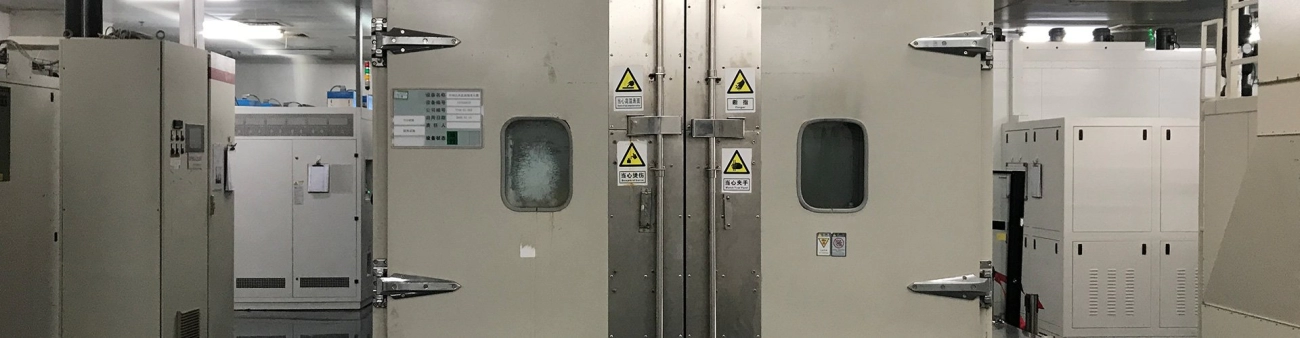
Damp heat test chambers and equipment
How 85°C/85% RH chambers are built
For a proper high temperature high humidity test for solar panels, the chamber matters more than most people think. A serious damp heat test solar panels setup usually includes:
- Stainless steel inner chamber – resists corrosion from constant 85°C/85% RH.
- Thick insulation and sealed doors – keeps temperature and humidity stable and stops moisture leaks.
- Steam or ultrasonic humidifier – to hit and hold the 85% RH target accurately.
- Powerful air circulation fans – to keep every PV module surface at nearly the same conditions.
- Condensate drain and water treatment – avoids mineral buildup that can affect humidity control.
If the chamber build is weak, you simply can’t trust DH1000 / DH2000 / DH3000 results.
Control, sensors, and calibration
For bankable results, I always insist on strict control and calibration:
- Temperature control:
- Setpoint: 85°C
- Accuracy: typically ±1–2°C
- Relative humidity control:
- Setpoint: 85% RH
- Accuracy: typically ±3–5% RH
- Sensors:
- PT100 or thermocouples for temperature
- Capacitive RH sensors for humidity
- Calibration:
- Regular calibration against traceable standards (ISO/IEC 17025 labs)
- Multi-point checks (low, mid, high range) before long campaigns
If the lab can’t show recent calibration reports, I treat their IEC 61215 damp heat data as suspect.
Loading patterns for full-size PV modules
Full-size modules (including large tropical climate solar modules up to 2.5+ m²) need smart loading patterns:
- Vertical or tilted mounting with gaps between modules to allow airflow.
- No shading or contact that can create cold spots and condensation pockets.
- Mixed orientation mapping (top/middle/bottom, front/back) to identify hot and humid extremes.
- Representative racking if we want to simulate real mounting stiffness.
Crowded, badly spaced racks will give uneven stress and misleading solar panel humidity resistance results.
Typical lab setup for damp heat testing
In a solid reliability lab, a damp heat test corner usually looks like this:
- Multiple 85/85 chambers with different capacities for mini-modules and full-size modules.
- Dedicated power and safety systems (over‑temp cutoffs, alarms, emergency stop).
- Staging area for pre‑ and post‑test work:
- Flash tester for IV curve and power checks
- Electroluminescence (EL) imaging station
- Insulation resistance / wet leakage current tester
- Data logging system to record:
- Chamber temp/RH trends
- Door open times
- Serial numbers and BOM for each module
When you’re sourcing for hot and humid markets (SEA, India, Gulf, Latin America), you want module partners who test in this kind of environment, not in a small, generic climatic box designed for electronics.
Step-by-Step Damp Heat Test Procedure (85°C/85% RH)
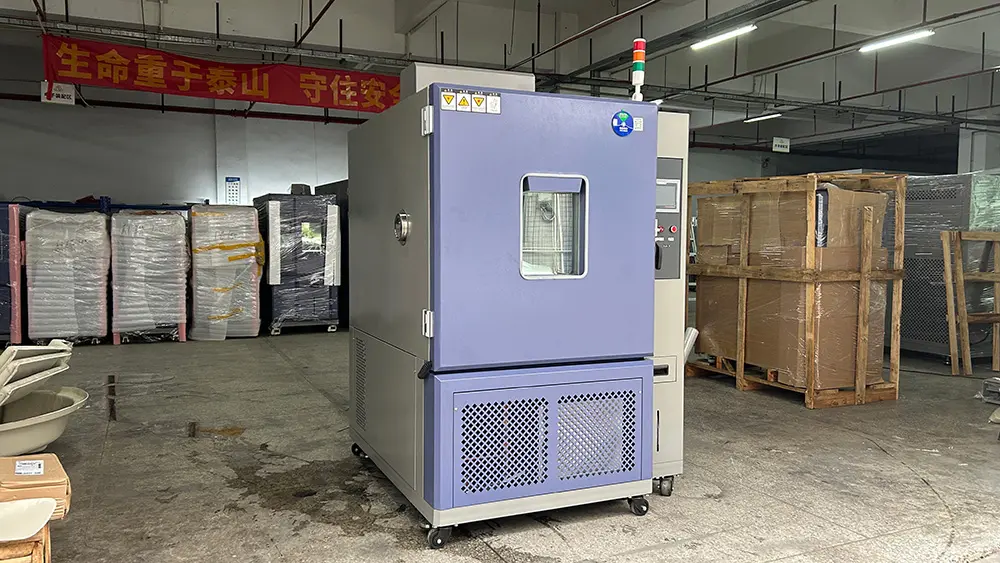
When I run a high temperature high humidity test for solar panels (the classic 85°C/85% RH damp heat test), I keep the process tight and repeatable. Here’s how a proper IEC 61215 damp heat test usually works in a lab.
Pre-conditioning and Baseline Measurements
Before any damp heat test for solar panels starts, I lock in the baseline:
- Visual inspection
- Check for cracks, bubbles, delamination, frame damage, junction box issues.
- Record photos of each module (front, back, labels).
- Flash test & IV curve
- Measure power (Pmax), Voc, Isc, fill factor under STC.
- Save full IV curves so we can compare after DH1000, DH2000, DH3000.
- Electroluminescence (EL) images
- Capture EL before testing to track micro-cracks, PID, dark areas later.
- Insulation / wet leakage tests
- Perform insulation resistance or wet leakage current test as per IEC 61215.
- These values are key for checking moisture ingress after the 85/85 exposure.
Setting Up Modules in the Damp Heat Chamber
Next, modules go into the 85°C / 85% RH test chamber:
- Mounting
- Modules are placed vertically or near-vertical to let condensate drain.
- No shading between modules; airflow must be uniform.
- Spacing and loading
- Keep clear gaps between modules for even temperature and humidity.
- Use non-corrosive racks and insulated supports so no stray currents or damage.
- Sensors and monitoring
- Chamber sensors checked and calibrated (temperature, relative humidity).
- Dummy or reference modules sometimes added to confirm conditions inside.
Running DH1000, DH2000, and DH3000 Hour Sequences
Then comes the actual damp heat test solar panels exposure:
- Standard DH1000
- 85°C, 85% RH, 1000 hours continuously (IEC 61215 damp heat).
- No power applied, modules are unpowered during the test.
- Extended DH2000 / DH3000
- Same 85/85 test photovoltaic conditions, but 2000 or 3000 hours total.
- Often done for tropical climate solar modules or bankability checks.
- Modules stay in the chamber for the full sequence; doors are not opened unless required.
- Control and records
- Temperature and RH must stay within the allowed IEC tolerance band.
- Lab logs any deviations, alarms, or chamber interruptions.
Cooldown, Recovery, and Stabilization Time
After the 85/85 exposure, I don’t test immediately; I let modules “recover”:
- Controlled cooldown
- Switch off heating and humidity, cool down modules slowly to room conditions.
- Avoid thermal shock or condensation on sensitive electrical points.
- Stabilization period
- Let modules rest at 25°C and ambient humidity for typically 12–24 hours (some labs use up to 48 h).
- This ensures moisture equilibrium and stable IV measurements.
- Post-DH testing
- Repeat visual inspection, flash test, IV curve, EL imaging, and insulation resistance test.
- Power loss, visual defects, and leakage data are then compared to baseline to judge DH1000, DH2000, and DH3000 performance.
This step-by-step process is what separates a real extended damp heat testing program from marketing claims. If a module survives this sequence with low degradation and no safety issues, I trust it more for hot and humid, tropical, coastal, or Gulf climate projects.
Performance Measurements Before and After High Temperature High Humidity (DH) Tests
When I run a high temperature high humidity test for solar panels (the classic 85°C/85% RH damp heat test), I always treat the measurements before and after as the real “truth check” on the module’s durability.
Flash Testing & IV Curve Comparison
I use flash testing and IV curve analysis before and after DH to see exactly
Common Failure Modes Under High Temperature and High Humidity

When I look at high temperature high humidity tests for solar panels (the classic 85°C/85% RH damp heat test), the same weak points show up again and again. Heat speeds up chemical reactions, and humidity pushes moisture deep into the module stack. Together, they attack every bad material choice, poor seal, and sloppy process.
Why Moisture and Heat Damage PV Modules
Under 85/85 damp heat test conditions (IEC 61215
Delamination, Bubbles, and Glass–Encapsulant Issues in Damp Heat
When we talk about a high temperature high humidity test for solar panels (the classic 85°C/85% RH damp heat test), delamination and bubbles between the glass and encapsulant are some of the biggest red flags for long‑term reliability.
Causes of Delamination Under Damp Heat
Under damp heat (IEC 61215 damp heat 85/85), moisture finds every weak point in the laminate. Delamination usually comes from:
- Poor lamination process
- Incomplete vacuum or low pressure during lamination
- Wrong cure time/temperature for EVA or POE
- Weak adhesion interfaces
- Incompatible combinations of glass, encapsulant (EVA/POE), and backsheet
- Low‑grade primers or surface treatments
- Edge design and framing issues
- Open frame corners, weak edge sealants, and cut backsheets
- Sharp edges or contamination at the glass–encapsulant interface
Once humidity gets in at 85°C/85% RH, these small process issues turn into full‑scale delamination.
Edge Seal and Lamination Problems
For hot and humid regions (SEA, India, Gulf, coastal Latin America), I pay close attention to:
- Edge seals
- Gaps at frame corners
- Sealant that doesn’t fully cover the laminate edge
- Cheap silicones that soften under heat and humidity
- Lamination quality
- Non‑uniform encapsulant thickness
- Trapped air from fast lay‑up or poor vacuum
- Inconsistent cure between batches (BOM variations)
If a module fails here in an extended damp heat test (DH2000, DH3000), it’s likely to struggle on a tropical rooftop or coastal ground‑mount.
How Bubbles, Voids, and Lifting Kill Power Output
Bubbles and voids look cosmetic at first, but they hit performance in a few ways:
- Less light to the cells
- Air gaps and lifted areas scatter light
- Local shading reduces current, especially in multi‑busbar / half‑cut cells
- Hot spots and local stress
- Uneven contact causes temperature differences across the cell
- Hot spots accelerate corrosion, EVA browning, and PID
- Faster moisture ingress
- Bubbles become moisture “channels” straight to the cell and metallization
- This speeds up snail trails, gridline corrosion, and backsheet issues
In damp heat test solar panels, even a small bubble area that grows during DH1000–DH3000 is a strong indicator of weak humidity resistance.
Visual Signs After High Temperature High Humidity Testing
After an 85/85 damp heat sequence, I always want a clean visual inspection, not just good flash test numbers. Things to look for:
- At the glass–encapsulant interface
- Milky or cloudy areas near the edges
- Visible “lifting” lines or separation between glass and encapsulant
- Bubbles around cell corners, busbars, or fingers
- Around the frame and edges
- Cracks or gaps in the edge sealant
- Moisture marks or “fogging” creeping in from the side
- On the cells themselves
- Localized dark patches that match delaminated zones
- Early snail trails starting from bubble locations
For global buyers (EPCs, IPPs, rooftop owners) in tropical climate solar modules markets, any of these signs after DH1000, DH2000, or DH3000 is a clear reason to push back on that BOM, or step up to POE encapsulant or dual-glass designs with stronger humidity resistance.
Junction box and cable failures in high temperature high humidity tests
In high temperature high humidity tests for solar panels (the classic 85°C/85% RH damp heat), junction boxes and DC cables are usually where “invisible” problems start. If these fail in a tropical site, you’re looking at string outages, hot spots, and major O&M headaches.
Adhesive and potting degradation
Inside the junction box, heat and moisture attack anything soft:
- Adhesives lose strength – junction box glue softens or cracks, so the box can lift off the backsheet or frame.
- Potting compounds (silicone/epoxy) age fast – they shrink, crack, or detach from cables and terminals, leaving paths for moisture ingress.
- Loss of creepage/clearance – once potting pulls away, you lose the original insulation distance, increasing the risk of arcing and leakage current.
For hot, humid markets (Southeast Asia, India, coastal Middle East, Latin America), I only trust junction boxes qualified in extended damp heat (DH2000/DH3000) with well-documented potting and adhesive materials.
Cable gland leaks and moisture ingress
Most real-world failures come from cheap or poorly installed cable glands:
- O-rings and seals harden or swell under 85/85, so the seal around the cable isn’t tight anymore.
- Incorrect tightening during assembly leaves micro-gaps that become capillary channels for moisture.
- UV + humidity crack low‑grade plastic glands, especially on rooftop systems.
For reliable solar panel humidity resistance, I insist on:
- IP67/IP68-rated junction boxes verified after damp heat testing.
- Branded cable glands with tested rubber compounds (EPDM, silicone) that survive hot and wet cycles.
- Proper strain relief so tension on the cable doesn’t open a path for water.
Diode and terminal corrosion issues
Inside the box, corrosion is the silent killer under damp heat:
- Bypass diodes corrode at leads and solder joints, increasing resistance and generating heat.
- Terminals and busbars oxidize, especially if plating is thin or mixed metals are used.
- Condensation inside the box accelerates corrosion; once there’s a thin water film, you can get electrochemical reactions even at low voltages.
You’ll see this in electroluminescence (EL) images and wet leakage tests after damp heat: dark cells, localized heating, or intermittent string behavior.
Preventive junction box design for hot and humid climates
For projects in tropical and coastal regions, I design/spec junction boxes with humidity in mind from day one:
- Fully potted or gel-filled junction boxes to block moisture ingress.
- High-quality, UL/IEC-certified diodes with proper derating for 85°C environments.
- Corrosion-resistant metals (tin-plated copper, stainless steel screws, robust plating thickness).
- Edge sealing and backsheet compatibility so the adhesive actually bonds long-term to the module surface.
- Clear BOM codes in test reports (IEC 61215 damp heat, IEC 61701 salt mist if coastal), so we know exactly which junction box model, adhesive, and potting compound were used.
When I select modules for hot and humid projects, I don’t just look at “passed damp heat test.” I cross-check:
- Junction box model, IP rating, and potting type
- Cable and gland specs
- DH1000/DH2000 results, wet leakage current values, and any notes on “borderline” corrosion
That’s how we avoid junction box and cable failures in the field and keep long-term solar module reliability in tropical climates under control.
EVA Yellowing, Browning, and Discoloration in High Temperature High Humidity Test for Solar Panels
In hot, humid markets, EVA yellowing and browning is one of the quiet performance killers I watch most closely in damp heat test solar panels (85°C/85% RH).
Why EVA Discolors Under Heat and Humidity
Standard EVA encapsulant can chemically break down when it sits for long periods at high temperature and high humidity:
- Peroxides and additives in EVA decompose and create chromophores (color centers).
- Moisture accelerates hydrolysis and oxidation, especially near edges and cells.
- UV in the field then “locks in” this discoloration, turning it from light tint to deep browning.
In real tropical climates (Southeast Asia, India, Gulf, coastal Latin America), this process is much faster than in mild climates, which is why IEC 61215 damp heat and extended DH1000/DH2000/DH3000 testing matters.
Impact on Light Transmission and Module Power
Once EVA yellows, the module is still electrically “fine,” but optically it’s not:
- Less light transmission: Yellow/brown EVA absorbs more blue and UV-rich light.
- Lower module power: It typically shows up as STC power loss and a drop in Isc on the IV curve.
- Uneven discoloration: Mismatch between strings or modules leads to local hot areas and uneven degradation.
In lab reports, strong yellowing after 85/85 shows up as higher % degradation even when there are no cracks or delamination.
How POE and Improved EVA Help in 85/85 Test Photovoltaic Modules
For hot and humid projects, I never rely only on “IEC passed” – I look at the encapsulant type:
- POE encapsulant
- Much better damp heat resistance and lower water vapor transmission.
- Far less yellowing and better PID resistance under PID testing 85°C 85% RH.
- Ideal for dual-glass solar panel reliability and coastal/tropical sites.
- Improved EVA formulations
- Low-yellowing EVA with better stabilizers and cross-linking.
- When paired with a good backsheet hydrolysis resistance stack, it holds up better in tropical climate solar modules.
For global buyers, especially EPCs and asset owners in humid regions, I strongly prefer POE or mixed POE/EVA for long-term solar panel humidity resistance.
Visual and Spectral Tests After Damp Heat Exposure
After DH1000, DH2000, DH3000 we verify discoloration, not just power:
- Visual inspection:
- Yellow/brown tint, especially around cell edges and busbars.
- Patchy areas or stronger browning near the frame or junction box.
- Spectral and performance checks:
- Flash test + IV curve: compare pre/post Pmax, Isc, Voc to quantify loss.
- Transmittance or haze measurements on coupons where available.
- Cross-check with electroluminescence testing after damp heat to separate optical loss from cell damage.
If a module shows low power loss and minimal yellowing after extended 85/85 test photovoltaic exposure, that’s a strong signal of a robust BOM (EVA vs POE encapsulant degradation, backsheet combination, and cell design) and better real-world durability in hot humid climate projects.
Corrosion, Snail Trails, and Metallization Issues in High Temperature High Humidity Tests
In high temperature high humidity tests for solar panels, corrosion of the silver grid and busbars is one of the first red flags. At 85°C / 85% RH, moisture and heat drive ion migration along micro-cracks and porous areas in the metallization. Silver can react with contaminants (like sulfur compounds from backsheets or the environment), forming dark corrosion products that increase series resistance and cut power.
Those dark, worm-like patterns we call snail trails are basically the visible symptom of this moisture-driven damage. They usually trace along micro-cracks in the cells and around silver fingers where corrosion and residue build up. In the lab, when I see snail trails after damp heat (DH1000–DH3000), I assume:
- Moisture protection is weak (encapsulant, backsheet, edge seal)
- Metallization or cell passivation isn’t robust enough for tropical or coastal climates
There’s also a tight link with Potential Induced Degradation (PID) in damp heat environments. Under 85°C/85% RH with high system voltage, leakage currents accelerate:
- Surface leakage across glass and encapsulant
- Corrosion at busbars and fingers
- Local shunts in the cell, which show up as dark, patchy zones in EL images
If the cell and coating stack isn’t PID-resistant, you get a combo of PID + corrosion, and performance crashes much faster than expected.
To reduce risk in hot and humid markets (Southeast Asia, India, Middle East, coastal Latin America), I only spec modules that combine:
- Optimized cell design
- Fine-line, robust silver pastes with good adhesion
- Crack-tolerant cell layouts (smaller cells, multi-busbar, SMBB)
- Strong passivation layers to limit ion migration
- Better coatings and materials
- High-quality AR glass with good surface treatments
- Low-Na glass to reduce sodium-driven PID routes
- POE encapsulant or PID-resistant EVA around the cells
In any damp heat test report or PVEL / independent lab data, I want to see:
- Minimal power loss from metallization and PID effects
- No significant snail trails or corrosion after DH1000–DH3000
- Clean EL images without widespread darkening or finger interruptions
If a module can keep the silver grid clean and EL patterns stable after extended 85/85 damp heat testing, it’s far more likely to survive real-world humidity, especially on large utility sites and coastal rooftops where downtime is expensive.
Backsheet Chalking, Cracking, and Hydrolysis in Damp Heat
High temperature high humidity test for solar panels is brutal on backsheets, but that’s exactly why I rely on it. If a backsheet can’t survive 85°C/85% RH (damp heat test per IEC 61215), it won’t last in Southeast Asia, India, the Gulf, or any coastal site.
How Humidity Attacks PV Backsheet Polymers
Under 85/85 damp heat conditions, moisture works its way into the backsheet and starts breaking chemical bonds:
- Hydrolysis breaks down PET and other weak polymer layers.
- Moisture + heat accelerate oxidation and UV damage already started in the field.
- Layer interfaces (encapsulant–backsheet, adhesive–film) lose adhesion and become pathways for water ingress.
You’ll usually see this earlier on thin, low-cost backsheets with poor hydrolysis resistance and high water vapor transmission rates.
Chalking, Embrittlement, and Micro-Cracks
When a backsheet is not designed for humid heat, DH1000–DH3000 tests often reveal:
- Chalking:
- White powder on the back surface.
- Outer layer is literally turning to dust.
- Indicates UV + hydrolysis breaking down the polymer chain.
- Embrittlement:
- Backsheet becomes stiff and fragile.
- Cracks when you bend it slightly or during thermal cycling.
- Micro-cracks and splits:
- Fine cracks around cell edges, busbars, or frame contact points.
- Can turn into through-cracks, exposing encapsulant and live parts to moisture.
All of this increases the risk of wet leakage current, insulation failure, and safety issues – exactly what IEC 61215 damp heat and wet leakage tests are meant to catch.
Hydrolysis-Resistant Backsheet Constructions
For hot and humid projects, I only take backsheets seriously if they use proven hydrolysis-resistant stacks, for example:
- PVDF/PET/PVDF or PVF/PET/PVF (fluoropolymer outer layers)
- Improved PET cores with hydrolysis stabilizers
- Strong encapsulant–backsheet adhesion, verified after DH2000 or DH3000
When I review BOMs and certificates, I always check:
- Backsheet type and manufacturer (not just “polymer backsheet”)
- Hydrolysis resistance claims backed by extended DH tests
- Results from PVEL damp heat scorecards or independent lab reports
Cheap PET/PET or unknown “white backsheet” stacks are red flags for tropical climates.
When to Move to Dual-Glass for Better Durability
In very humid or coastal markets, dual-glass (glass-glass) modules avoid most backsheet hydrolysis risks altogether:
Why dual-glass helps in humidity:
- Much lower moisture ingress vs typical backsheets
- No backsheet to crack, chalk, or delaminate
- Better long-term insulation resistance under damp heat
Where I push dual-glass strongly:
- Utility-scale projects in tropical and monsoon regions
- Coastal and near-sea plants with high humidity and salt mist
- Sites with long financing horizons (20–30 years) where every % of degradation hits LCOE
You still need solid encapsulant (POE or high-grade EVA) and good edge sealing, but dual-glass gives a clear reliability edge in hot and humid climates. For global customers building in these regions, choosing hydrolysis-resistant backsheets or dual-glass designs is non-negotiable if you want bankable, low-maintenance plants.
Potential Induced Degradation Under Humidity (PID in Damp Heat)

When we talk about high temperature high humidity test for solar panels, PID is one of the big risks that can quietly kill performance in hot, wet climates.
How high temperature and humidity amplify PID
In simple terms, Potential Induced Degradation (PID) happens when high system voltage pushes leakage currents through the module, usually from cells to frame or glass. Under 85°C and 85% RH (“85/85”) this gets much worse because:
- Moisture lowers insulation resistance, so current finds more leakage paths.
- High temperature speeds up ion movement (mainly sodium ions from the glass), which attack cell surfaces and passivation.
- Damp heat + high voltage = faster, deeper PID, especially on large utility projects running at 1,500 V in tropical or coastal climates.
If you’re building in Southeast Asia, India, the Gulf, or any humid coastal region, PID risk under damp heat is not theoretical—it directly impacts long‑term yield.
PID test setups at 85°C/85% RH with high voltage bias
To see how robust a module really is, we push it with PID testing at 85°C/85% RH under DC bias:
- Standard setup:
- Chamber at 85°C / 85% RH
- ±1,000 V to ±1,500 V DC applied between cells and frame/glass
- Duration often 96–168 hours, or longer for stricter programs
- Framed vs. frameless: Framed modules with grounded frames are more prone if the design and encapsulant are weak.
- Objective: Measure how much power loss and leakage current appears under realistic worst‑case field conditions.
Any serious supplier targeting tropical climate solar modules should have PID tests under 85/85 as part of their reliability package, not just basic IEC 61215 damp heat.
Recognizing PID patterns in EL images
The easiest way to “see” PID is through electroluminescence (EL) imaging before and after the 85/85 PID test:
- Typical PID signs on EL:
- Darkening of full cells or entire strings
- Strong power loss on cells closest to the high‑voltage side
- Patchy patterns that align with system polarity
- Link to IV curves:
- Drop in Voc and Pmax
- Increased mismatch between strings
If EL images show large dark areas or string‑level dark zones after PID testing, that module is not fit for long‑term high‑voltage operation in humid, hot regions.
Mitigation with anti-PID cells and grounding design
We tackle PID under humidity at both product level and system design level:
- On the module side:
- Use anti-PID cell technologies (special cell passivation and emitter designs)
- Choose POE encapsulant or PID‑resistant EVA with lower ion mobility
- Apply better edge sealing to keep moisture out and control leakage paths
- On the system side:
- Smart grounding design (e.g., negative grounding where appropriate, or transformer‑based inverters when required)
- PID recovery modes in inverters (night‑time reverse bias)
- Avoid unnecessary floating high voltage in very humid sites
For high temperature high humidity test for solar panels, I always look at PID test data at 85°C/85% RH, EL images, and degradation percentage together. That’s what tells me if a module will hold up on a 25‑year project in real tropical and coastal conditions—not just on paper.
Real-World Damp Heat Test Results for Solar Panels
Why not all “pass” results are equal
On paper, most panels “pass” the high temperature high humidity test for solar panels (IEC 61215 damp heat, usually DH1000 at 85°C/85% RH). In practice, those passes are not the same:
- A module that loses 0–1% power after DH1000 is in a very different league than one that loses 4–5% but still squeaks under the limit.
- Some brands only test a “golden” BOM; the mass‑produced version may use cheaper backsheets, EVA, or junction box materials that won’t match that result.
- Many certificates show only DH1000; serious suppliers for tropical climates also publish DH2000 / DH3000 and PID-at-85/85 data.
When I buy or specify modules, I treat “pass IEC 61215 damp heat” as the starting point, not the decision point.
How different module designs compare under damp heat
In real DH1000 / DH2000 / DH3000 campaigns, you usually see clear trends:
- Dual-glass vs backsheet
- Dual-glass modules typically show lower moisture ingress, less backsheet cracking, and better EL images after DH.
- Backsheet modules can perform well, but only with hydrolysis‑resistant backsheets and matching encapsulants.
- EVA vs POE encapsulant
- Standard EVA can show yellowing, acetic acid formation, and higher PID risk under 85/85.
- POE encapsulant generally delivers better damp heat resistance, lower water vapor transmission, and stronger PID robustness.
- Anti-PID cells and edge design
- Cells with anti-PID treatments, improved edge sealants, and higher IP‑rated junction boxes show much lower EL darkening and leakage issues after extended damp heat.
The gap between a “basic” design and a tropics-optimized module becomes obvious once you look at DH2000 and DH3000 data side by side.
Using degradation data to predict field life
For hot and humid regions (Southeast Asia, India, Gulf, coastal Latin America), I use damp heat results as a shortcut to field behavior:
- Degradation ranges to watch
- DH1000: ≤2% power loss is solid for tropical projects; >3–4% is a red flag.
- DH2000: strong designs stay within 3–4%; weaker ones can drift past 6–8%.
- DH3000: best-in-class modules still hold <5–6%, which aligns with reliable 25–30 year field life in humid climates.
- Field-life estimation (rough rule of thumb)
- Low, stable degradation in DH2000/DH3000 → lower annual field degradation (~0.4–0.6%/year) in hot, humid sites.
- Sharp jumps in DH results → expect early issues: delamination, backsheet cracking, PID, and faster real-world loss.
When I negotiate PPAs or warranties, I tie high temperature high humidity test performance directly to:
- Long-term warranty strength (especially in tropical climate solar modules)
- LCOE assumptions
- Bank and insurer confidence
If the supplier can’t show clean DH1000 / DH2000 / DH3000 curves and EL images, I assume the risk is on my balance sheet, not theirs.
Interpreting DH1000, DH2000, and DH3000 Data
When I look at damp heat test solar panels data (DH1000 / DH2000 / DH3000 at 85°C/85% RH), I treat it as a stress-test of real field risk in hot, humid, or tropical sites.
Typical degradation ranges (DH1000 / DH2000 / DH3000)
As a practical benchmark for modern IEC 61215 damp heat-certified modules:
- DH1000 (1,000 hours)
- Tier-1 / good BOM: usually ≤1–2% power loss
- Borderline: 2–5% loss
- Red flag: >5% loss or visual damage
- DH2000 (2,000 hours)
- Robust designs: typically ≤3–4% total loss
- Mid-range: 4–8% total loss
- DH3000 (3,000 hours)
- Best-in-class dual-glass + POE: often ≤5–6%
- Anything >10% by DH3000 is a concern for harsh tropical climates
These are not formal limits, but realistic ranges from PVEL damp heat, third‑party labs, and our own projects in Southeast Asia, India, the Gulf, and coastal Latin America.
Linear vs non‑linear degradation trends
I don’t just check “pass/fail”; I look at the degradation curve across DH1000, DH2000, DH3000:
- Good sign (near-linear / flat):
- Small step from 0 → DH1000 (≤2%)
- Then similar or slowing loss from DH1000 → DH2000 → DH3000
- Suggests stable materials (POE encapsulant, hydrolysis‑resistant backsheet, strong edge seal)
- Bad sign (non‑linear “hockey stick”):
- Low loss at DH1000 (e.g. 1–2%), but
- Sharp jump after DH2000 (e.g. suddenly 7–10%+ after DH3000)
- Usually linked to moisture ingress, EVA browning, backsheet cracking, or early PID under humidity
Non‑linear jumps tell me the module might look fine in year 1–3 but start failing hard from year 5–8 in hot and humid climates.
When the extra 1,000 hours really matters
The extra DH2000 / DH3000 is where weak designs fall apart. I push for extended 85/85 test photovoltaic data when:
- Projects are in:
- Tropical / monsoon climates (Thailand, Vietnam, Malaysia, Indonesia, Bangladesh)
- Humid coastal or Gulf sites (UAE coast, Oman, Red Sea, Caribbean, Southeast Brazil)
- BOM uses:
- EVA only encapsulant with standard backsheets
- New or unproven backsheet stacks
- Projects are utility-scale, financed, or 25–30 year PPA
(small rooftop can sometimes live with DH1000, big portfolios cannot)
Often, two modules both “pass” DH1000, but only one stays under ~5% loss by DH3000. That’s the one I trust for long‑term solar module longevity in hot humid climate.
How banks and insurers look at extended damp heat testing
For global investors, lenders, and insurers, extended damp heat testing is a risk filter:
- DH1000 only:
- Seen as “basic IEC 61215 compliance”, not a strong durability signal
- DH2000 with solid results:
- Usually enough for mid‑risk climates or inland sites
- Strengthens the case for warranty bankability and lower degradation assumptions
- DH3000 with low loss and clean EL images:
- Treated as premium reliability proof for tropical, coastal, and high‑humidity projects
- Often improves:
- Assumed annual degradation in financial models
- Comfort level with longer performance warranties
- Insurance terms in harsh climates
When I select modules for hot and humid sites, I tie DH1000 / DH2000 / DH3000 data directly into LCOE and risk: flat curves and low loss win, even if upfront price is slightly higher.
Benchmarking Against Tier-1 Module Performance in High Temperature High Humidity Test
Average Tier-1 damp heat results from PVEL and labs
When I look at PVEL, TÜV, and other independent lab data for 85°C/85% RH damp heat test (DH1000–DH3000), Tier-1 modules generally sit in these bands:
- DH1000 (IEC 61215 damp heat)
- Typical Tier-1: -0.5% to -2.5% power loss
- Anything worse than -3% is already below market expectation
- DH2000
- Solid Tier-1 range: -1.5% to -4%
- DH3000
- Bankable range: -2.5% to -5%
If a “Tier-1” brand is above these numbers, especially under hot and humid / tropical climate positioning, I treat the humidity resistance as questionable and dig deeper into BOM and test conditions.
How premium materials shift the curve
In real projects, I see premium materials change the damp heat curve a lot:
- POE encapsulant vs EVA
- POE significantly reduces moisture ingress, PID, and yellowing
- You typically see 1–2% less degradation at DH2000/DH3000 with good POE
- Dual-glass vs backsheet
- Dual-glass modules usually show flatter degradation in DH2000–DH3000
- Less delamination, backsheet cracking, and hydrolysis issues
- Hydrolysis-resistant backsheets + upgraded encapsulant
- Multilayer “UV-cut + hydrolysis-resistant” backsheets hold up far better in tropical humidity
When you combine POE + dual-glass + anti-PID cells + good edge seal, the damp heat test solar panels curve shifts from “barely pass” to “long-term stable.”
What counts as “best-in-class” DH performance
For 85/85 test photovoltaic performance, my rough benchmark for best-in-class is:
- DH1000: ≤ -1% power loss
- DH2000: ≤ -2%
- DH3000: ≤ -3% and no serious visual defects
- No:
- Delamination, bubbles, or backsheet chalking
- Severe EVA yellowing/browning
- Snail trails, corrosion, or wet leakage failures
If a module claims “tropical climate ready” but loses >5% at DH3000, I don’t consider it best-in-class, no matter how nice the brochure looks.
Using third-party scorecards in due diligence
For global buyers, EPCs, and asset owners, I always bring it back to independent data:
- Use PVEL Scorecard, TÜV, UL, PI Berlin, RETC reports
- Check:
- Exact test level: DH1000 vs DH2000 vs DH3000
- Degradation percentage and number of samples
- BOM codes (EVA vs POE, backsheet brand, dual-glass, etc.)
- Compare multiple brands side by side:
- Focus on DH2000/DH3000, not just IEC DH1000 pass/fail
- Prioritize modules with low degradation + clean EL imaging + no wet leakage issues
My rule: in hot and humid markets (Southeast Asia, India, Gulf, coastal LatAm), I only shortlist suppliers whose damp heat test results are independently verified and clearly better than average Tier-1, not just “IEC certified.”
Materials That Improve High Temperature High Humidity Reliability
When we talk about high temperature high humidity test for solar panels, materials matter more than any certificate on the cover page. You don’t buy a logo; you buy a Bill of Materials (BOM).
Why material selection matters more than the certificate
A module can “pass IEC 61215 damp heat” on paper and still age fast in a tropical climate if the BOM is weak. What really drives solar panel humidity resistance and long-term output is:
- Encapsulant: standard EVA vs POE or advanced EVA (yellowing, PID, water vapor barrier).
- Backsheet or glass: hydrolysis‑resistant backsheets or dual‑glass for better moisture control.
- Sealants & adhesives: edge seal, junction box glue, potting compounds in 85/85 conditions.
- Cells & coatings: anti‑PID cells, better metallization, improved AR coatings.
Same certificate, different materials = completely different field results. That’s why I always push customers to look at the BOM first, certificate second.
Trade‑offs between cost, reliability, and bankability
For hot and humid markets (Southeast Asia, India, Middle East, coastal LatAm), the trade‑offs are clear:
- Lowest upfront cost
- Cheap EVA, basic backsheet, minimal edge seal.
- Higher risk of delamination, backsheet cracking, EVA browning after a few years.
- Balanced, bankable option (what I usually spec)
- POE or high‑grade EVA on at least one side, hydrolysis‑resistant backsheet or dual‑glass.
- Proven DH1000–DH3000 and PID testing 85°C/85% RH from an independent lab.
- Premium, long‑life build
- Dual‑glass + POE both sides, anti‑PID cells, robust junction box design.
- Slightly higher CAPEX, but lower LCOE and easier finance with banks and insurers.
If your site is tropical, coastal, or desert‑edge humid, cutting corners on materials is the fastest way to lose energy yield and warranty value.
How to read BOM details in datasheets and reports
Never stop at “IEC 61215” on the datasheet. Go one level deeper and check the actual BOM:
- Datasheet & IEC certificate
- Look for BOM IDs (e.g., BOM A1, A2) tied to DH1000 / DH2000 / DH3000 results.
- Check if it clearly states: EVA vs POE, backsheet model, glass type, cell type.
- Test reports (PVEL, TÜV, UL, PI Berlin, local labs)
- Confirm which BOM was tested under 85°C/85% RH.
- Match the tested BOM code to the BOM listed for your supply.
- Watch for tiny notes like “BOM may vary by region” – this is a red flag unless fully disclosed.
- What I ask suppliers directly
- “Which exact BOM (encapsulant, backsheet, glass, cell type) will you ship to this project?”
- “Show me the damp heat test solar panels report for this exact BOM, not a different one.”
If the supplier can’t clearly match BOM → DH test report → product you receive, I walk away. In hot and humid climates, solid material choices are your real insurance policy, not just the certificate logo.
POE vs EVA in Damp Heat Conditions
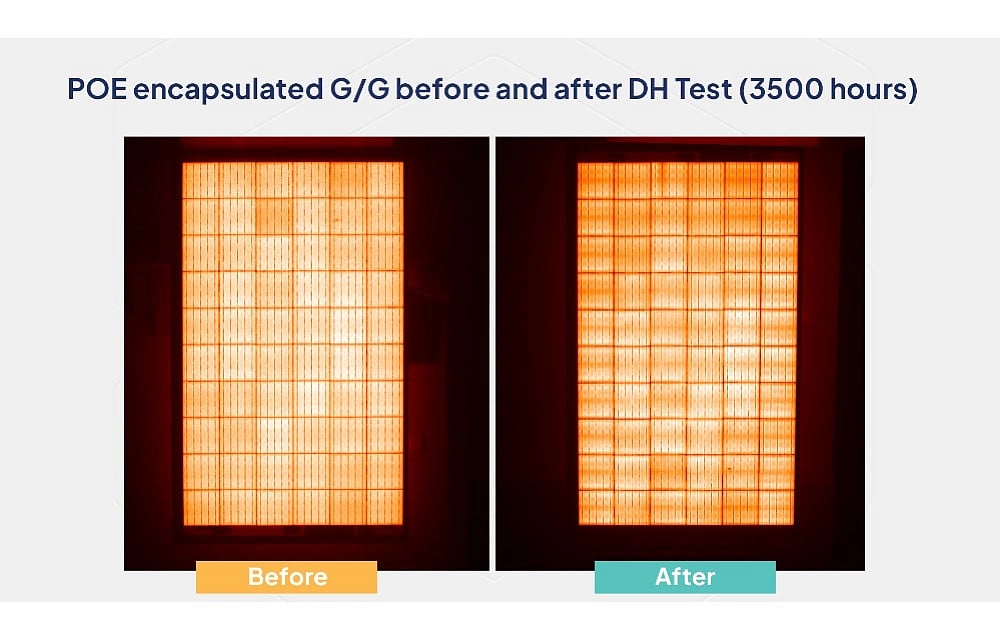
When I look at solar panel reliability in hot, humid regions, POE vs EVA in damp heat conditions is one of the biggest levers we can pull. The encapsulant choice directly affects damp heat test solar panels, PID risk, and long‑term power loss.
Key differences between EVA and POE encapsulants
EVA (Ethylene Vinyl Acetate)
- Widely used, cheaper, very mature in the market
- More sensitive to moisture, UV, and heat, especially over 10–20 years
- Higher risk of yellowing, acetic acid formation, and corrosion
POE (Polyolefin Elastomer)
- Lower water absorption and lower water vapor transmission rate (WVTR)
- Better electrical insulation and much stronger PID resistance
- More stable in IEC 61215 damp heat and extended DH1000 / DH2000 / DH3000 hours
In short: EVA is cost-effective, but POE is the durability play for high temperature high humidity test for solar panels.
Damp heat resistance and water vapor transmission
Under 85°C/85% RH (85/85 test photovoltaic) conditions:
- EVA lets more moisture migrate into the cell area and busbars
- POE acts like a stronger barrier, slowing moisture ingress in PV modules
- In repeated damp heat test solar panels cycles, POE typically shows:
- Less delamination
- Less corrosion
- Lower wet leakage current and better insulation resistance
This is why many Tier‑1 BOMs switch to POE or POE+EVA stacks in tropical climate solar modules.
Impact on PID, yellowing, and long-term power loss
- PID (Potential Induced Degradation)
- EVA: higher ionic mobility and moisture → more PID under PID testing 85°C 85% RH
- POE: better insulation, lower ion migration → much lower PID risk, especially at high system voltage (1,500 V)
- Yellowing & Discoloration
- EVA: can yellow or brown under damp heat + UV → lowers light transmission → visible power loss
- POE: much more color-stable → keeps front-side transparency and higher energy yield
- Long-term Power Loss
- EVA: acceptable in mild climates, but in hot and humid regions, you see faster solar module degradation
- POE: typically shows lower degradation in DH1000/DH2000/DH3000 and better field performance over 10–20 years
When to spec POE for hot and humid projects
I strongly recommend specifying POE encapsulant for PV modules in these cases:
- Tropical / coastal / high humidity sites:
- Southeast Asia, India, Bangladesh
- Gulf & coastal Middle East
- Tropical Latin America and Africa
- High system voltage (1,500 V) where anti PID solar cells and strong insulation matter
- Dual-glass solar panel reliability projects where you’re pushing for 30+ year lifetimes
- Utility-scale plants where LCOE and bankability matter more than a tiny CAPEX saving
When you’re evaluating offers:
- Ask clearly: “Is the BOM EVA, POE, or mixed?”
- Check test reports for extended damp heat testing (DH2000 / DH3000) and PID testing at 85°C/85% RH
- Prioritize modules that combine:
- POE encapsulant
- Proven anti PID cell technology
- Strong backsheet hydrolysis resistance or dual-glass design
For hot and humid projects, POE is not a luxury—it’s usually the difference between “meets warranty on paper” and real-world, low-degradation performance.
Dual-glass vs backsheet modules in humidity
When you’re building in hot, humid, or coastal regions, dual-glass modules almost always beat backsheet modules on long-term durability. The damp heat test (85°C/85% RH) makes the difference very clear.
How dual-glass reduces moisture ingress
Dual-glass (glass-glass) modules seal the cells between two glass layers instead of one glass + polymer backsheet. That matters a lot in tropical and coastal climates:
- Lower moisture ingress:
- Glass is a much better barrier than most backsheets.
- Less water vapour reaches the cells, busbars, and ribbons.
- Better resistance to damp heat, PID, and corrosion in 85/85 conditions.
- More stable encapsulant:
- Works especially well with POE encapsulant in DH1000–DH3000 tests.
- Less delamination, fewer bubbles, less backsheet hydrolysis risk.
- Better performance in tropical climates:
- Ideal for Southeast Asia, India, Gulf coast, Latin America, and rainforest zones.
- Degradation rates stay lower and more predictable under high humidity.
Mechanical and weight considerations
Dual-glass isn’t perfect for every roof. You have to think mechanical and handling:
- Heavier modules:
- Typically 2–4 kg heavier per module than backsheet types.
- Roof structure and mounting need to handle extra weight and wind loads.
- Stronger and stiffer:
- Better resistance to micro-cracks and cell breakage.
- Good for ground-mount and utility-scale where handling is controlled.
- Handling and installation:
- Need better lifting practices and storage.
- For small rooftop installers, backsheet modules may be easier to manage.
Backsheet pros and cons in tropical climates
Backsheet modules can still work in hot and humid locations, but only if the BOM (bill of materials) is serious quality:
Pros:
- Lighter and easier to install on weak rooftops.
- Often cheaper upfront, which matters for tight CAPEX projects.
- Wide choice from many Tier-1 suppliers.
Cons in humidity:
- Risk of backsheet cracking, chalking, and hydrolysis under damp heat.
- Higher chance of moisture ingress, snail trails, and delamination.
- More sensitive to poor material combinations (wrong EVA + backsheet stack).
- Needs strong IEC 61215 damp heat, IEC 63209-1, and PVEL scorecard proof for DH1000–DH3000.
Project types where dual-glass gives best ROI
From my side as a project owner/platform operator, I usually push dual-glass in these cases:
- Utility-scale and large C&I in:
- Coastal and Gulf regions (Saudi, UAE, Oman, Red Sea, Arabian Sea)
- Tropical Asia (Thailand, Vietnam, Malaysia, Indonesia, Philippines)
- Humid Latin America and Caribbean
- Sites with high humidity + high temperature + high voltage:
- Central inverters, long strings, PID risk is real.
- Plants targeting 25–30+ year lifetime with low degradation:
- LCOE-driven investors; banks like strong damp heat and PID at 85°C/85% RH results.
Where I still consider backsheet:
- Light rooftop structures that can’t tolerate extra weight.
- Projects where labour or logistics for dual-glass are complicated.
- Only if the supplier shows:
- Strong DH1000/DH2000/DH3000 results
- Verified backsheet hydrolysis resistance
- Clear BOM codes, not swapped behind the scenes.
The verdict from environmental test chamber manufacturers is clear: in humid, tropical, or coastal markets, dual-glass modules with POE are the safer long-term bet. Backsheet modules can work—but only with top-tier materials, proven damp heat performance, and strict BOM control.
Anti-PID Cells, Edge Sealants, and Junction Box Design
When we talk about high temperature high humidity test for solar panels, PID and moisture go hand in hand. If we don’t design for this upfront, DH1000 / DH2000 / DH3000 will expose it very quickly.
Cell technologies that reduce PID risk
To cut PID risk at 85°C/85% RH, I focus on the cell and glass stack first:
- Anti-PID cells
- Optimized emitter and passivation to reduce leakage currents
- PID-resistant cell architectures (e.g. improved p-type, n-type, TOPCon, HJT)
- Better surface coatings to limit sodium migration from the glass
- Glass and encapsulant pairing
- POE encapsulant instead of standard EVA on the high-voltage side
- Low-sodium or tempered glass options where budget allows
- System-level impact
- Lower PID sensitivity lets us run higher system voltages (1,500 VDC) safely in tropical and coastal climates
In 85/85 PID tests, anti-PID cells show much lower power loss and cleaner EL images, even after high-voltage bias.
Improved edge sealing and frame design
Most moisture doesn’t come through the middle of the module – it creeps in from the edges. That’s why edge sealing and frame design are critical:
- Edge sealants
- Use high-grade edge sealant tapes or silicones with low water vapor transmission
- Full corner coverage and no gaps around the frame
- Consistent lamination pressure and time to avoid micro-voids
- Frame design
- Drainage holes placed to avoid water pooling at the lower frame
- Sufficient clamping area without crushing the laminate
- Proper gap between frame and glass/bottom surface to avoid “wicking” of water
In damp heat test solar panels, good edge sealing means less delamination, fewer bubbles, and lower wet leakage current after DH exposure.
Junction box adhesives, IP rating, and potting
The junction box is often the weak link in hot and humid regions:
- Adhesives
- Use proven junction box adhesives tested under DH1000/DH2000
- No partial bonding – full contact between box and backsheet or glass
- IP rating
- Aim for IP67 or better for tropical sites, especially coastal and industrial rooftops
- Cable glands must lock tightly and maintain seal over time
- Potting compounds
- Stable potting material that doesn’t crack, shrink, or absorb water
- Good coverage over diodes and terminals to prevent corrosion and arcing
Poor choices here show up as moisture ingress, diode failure, and insulation resistance drops during wet leakage current tests.
How these choices show up in DH test results
All these design details become very visible under IEC 61215 damp heat and PID testing at 85°C/85% RH:
- Anti-PID cells + POE
- Lower power loss after DH and PID (often <2–3% at DH2000 for strong designs)
- EL images show fewer dark areas and typical PID “patterns” are minimal
- Robust edge sealing and frame
- Little to no delamination, bubbles, or backsheet cracking
- Insulation resistance and wet leakage stay well above IEC limits
- Well-designed junction box
- No corrosion on terminals or diodes
- Stable IV curves and no unexpected open-string or hot spot issues
When I review high temperature high humidity test reports, I always link design choices directly to DH1000 / DH2000 / DH3000 performance. If a module is truly built for hot and humid climates, it will show stable power, clean EL, and strong insulation results under extended damp heat and PID stress.
Backsheet and Encapsulant Combinations for Tropics
UV‑cut and hydrolysis‑resistant backsheets
In hot, humid, high‑UV regions, the backsheet is a common weak point. I always push for:
- UV‑cut outer layer (e.g. fluoropolymer or UV-stabilised coating) to shield the inner layers.
- Hydrolysis‑resistant core (PET alone is risky; PET + barrier or reinforced structures are better).
- Proven tropical track record – ask for field data from Southeast Asia, India, Middle East, or Latin America, not just IEC 61215 damp heat test claims.
If the backsheet fails, you’ll see chalking, cracking, and insulation loss long before the warranty ends.
Matching encapsulant chemistry to backsheet
Encapsulant + backsheet is a system. In damp heat:
- EVA + standard PET backsheet → higher risk of acetic acid formation, corrosion, and hydrolysis.
- EVA + hydrolysis‑resistant backsheet → acceptable for many sites, but I still treat it as mid-tier.
- POE + robust backsheet → much better for humidity, PID resistance, and long‑term stability.
- Glass–glass + POE → best option for harsh tropical and coastal sites if structure and BOS can handle the weight.
The goal is low water vapor transmission, low chemical reactivity, and stable adhesion under 85°C/85% RH.
Common bad combinations to avoid
For tropical solar projects, I avoid these pairings:
- Single‑layer PET backsheets with EVA in high humidity – classic recipe for backsheet cracking and hydrolysis.
- Cheap “no‑name” backsheets with no PVEL or third‑party data.
- EVA on both sides + weak edge sealing in coastal or rainforest sites – moisture ingress and PID risk go up fast.
If the supplier can’t clearly state the backsheet stack and encapsulant, I treat that as a red flag.
Checking BOM codes in certificates and scorecards
Never assume “IEC certified” means your exact module version is robust in damp heat. Check:
- BOM (Bill of Materials) codes in IEC 61215 damp heat reports, IEC 63209-1 long‑term test reports, and PVEL scorecards.
- Backsheet brand, model, and structure: e.g. “fluoro-PET-fluoro”, “fluoro-PET-barrier”, not just “polymer backsheet”.
- Encapsulant type clearly listed as EVA or POE (or mix) – with manufacturer and grade, if possible.
If the serial number range or BOM listed in the report doesn’t match the modules being sold into your tropical project, push back. For hot and humid markets, BOM transparency is non‑negotiable.
Performance of Solar Panels in Tropical and Humid Regions
Climate challenges in Southeast Asia, India, and the Middle East
In hot, humid markets like Southeast Asia, India, and parts of the Middle East, solar panels are pushed harder than in mild European climates. You’re dealing with:
- High temperature: 35–45°C daytime ambient, rooftop surfaces easily above 60°C.
- High humidity: Often >70% RH, with long wet seasons and heavy rainfall.
- Intense UV and pollution: Accelerates aging of encapsulant and backsheet.
- Unstable grids and high DC voltage: Increases risk of PID and leakage issues.
For asset owners, this means you can’t just pick any “IEC-certified” module and hope for the best. You need panels that are proven in damp heat test solar panels conditions, not just in theory.
Gulf, coastal, and rainforest site conditions
Within these regions, site conditions vary a lot:
- Gulf and Middle East coastal sites (UAE, Oman, Saudi Arabia):
- Hot nights, high humidity, salt-laden air
- Strong corrosion risk for junction boxes, frames, and connectors
- Southeast Asia rainforest and coastal areas (Thailand, Vietnam, Malaysia, Indonesia, Philippines):
- Constant moisture, frequent rain, very slow drying of modules
- Higher chance of moisture ingress in PV modules, delamination, and snail trails
- Indian coastal and inland plains:
- Coastal: humidity + salt mist + pollution
- Inland: high temperature, seasonal humidity spikes, dust combined with heat
If we’re supplying modules to these markets, we spec materials (encapsulant, backsheet, junction box, edge seal) specifically for tropical climate solar modules, not just generic BOMs.
How lab damp heat results translate into field data
The 85°C/85% RH damp heat test (IEC 61215 damp heat, 85/85 test photovoltaic) is our main lab shortcut to predict how modules will behave on these sites:
- DH1000 (1000 hours) roughly correlates to ~10+ years in many tropical and subtropical locations when the design is solid.
- DH2000 / DH3000 gives a clearer picture of long-term risk for:
- Backsheet hydrolysis resistance
- EVA vs POE encapsulant degradation
- Junction box and cable sealing quality
- Potential Induced Degradation (PID) under humidity
What we look for in our own and third-party data:
- Low power loss:
- After DH1000: ideally <2–3% degradation
- After DH2000/3000: still clearly <5–8%, no sudden jumps
- Clean visuals and EL:
- No delamination, bubbles, backsheet cracks, or heavy snail trails
- No new hotspots, PID patterns, or cell darkening on EL images
- Stable insulation resistance / wet leakage:
- Passes wet leakage current test with margin even after DH
When a module design consistently shows low degradation in DH1000, DH2000, and DH3000 hours, we see that mirrored in the field: slower annual degradation, fewer early failures, and stronger performance ratios in tropical and humid projects.
That’s why, for global customers in these climates, I insist on modules with extended damp heat testing and transparent lab reports. It’s the most practical way to protect yield, warranties, and LCOE in hot, humid regions.
Field Data From Hot and Humid Solar Installations
In hot, humid regions, real-world data is often harsher than the brochure. That’s why I treat high temperature high humidity test for solar panels and real field monitoring as equally important.
Degradation Rates in Tropical Projects
From monitored plants in Southeast Asia, India, the Gulf, and coastal Latin America, we typically see:
- Well-designed modules (Tier-1, strong damp heat test results):
- Inland tropical sites: 0.5–0.8%/year power loss
- Coastal humid sites: 0.7–1.0%/year
- Average modules (basic IEC 61215 pass, weaker materials):
- Inland: 0.8–1.2%/year
- Coastal / high humidity: 1.2–1.8%/year, sometimes higher
When a brand shows good DH1000/DH2000 results plus consistent field data, I consider that bankable for tropical deployments.
Coastal vs Inland Performance
Humidity plus salt and high temperature makes a big difference:
- Coastal / near-sea projects:
- Faster backsheet chalking and cracking
- More corrosion on junction boxes, connectors, and frames
- Earlier PID and snail trails, especially at high system voltage
- Inland tropical / humid plains:
- Less salt, but still strong damp heat stress
- EVA yellowing and delamination show up earlier on low-cost modules
- Performance gap grows after year 5
If your site is <20 km from the coast or in a rainforest / monsoon zone, I always push for modules with extended damp heat testing (DH2000/DH3000) and proven coastal field references.
Common Patterns: PID, Delamination, Backsheet Issues
In real tropical systems, the same patterns keep repeating:
- PID (Potential Induced Degradation):
- Shows in EL images as dark, patchy cells on one side or string-wise
- Often accelerates after 2–4 years in hot, humid plants at 1,500 V
- Strongly linked to weak encapsulant choice and no anti-PID design
- Delamination & bubbles:
- Start from module edges, corners, or around the junction box
- More common where lamination process or edge seal is weak
- Leads to moisture ingress, hot spots, and faster power loss
- Backsheet issues:
- Chalking (white powder), micro-cracks, rear-side “crazing”
- Typical on older or cheaper backsheet chemistries with low hydrolysis resistance
- Often correlates with higher wet leakage current and insulation failures
When I see these issues early (years 3–6), I know the damp heat resistance of that module design is not enough for tropical sites.
What 5–10 Years of Monitoring Data Tells Us
Long-term SCADA and on-site test data line up closely with extended damp heat test results:
- Plants using dual-glass + POE + anti-PID cells:
- Lower spread between strings
- Degradation staying close to 0.5–0.7%/year, even in coastal humidity
- Plants using mixed or low-cost BOMs:
- Big performance gaps between arrays (5–10% difference by year 8–10)
- More offline strings due to insulation faults and junction box problems
- Monitoring confirms:
- Early power loss often tracks back to PID and moisture ingress
- High failure rates in strings that face prevailing wind + salt spray
- Modules with strong IEC 61215 damp heat, IEC 63209-1, and solid PID 85°C/85% RH testing keep a higher effective yield and fewer warranty fights
For global customers building in hot and humid regions, I always recommend linking lab results (DH1000/DH2000/DH3000, PID 85/85) with real field references in similar climates before locking in a module supplier. That’s how you protect long-term yield, not just hit COD.
Case Studies in Southeast Asia and South Asia
Utility-Scale in Thailand and Vietnam
In Thailand and Vietnam, high temperature high humidity tests for solar panels (the classic 85°C/85% RH damp heat test) turned out to be very good predictors of real field behavior.
From the sites we’ve been involved in:
- Thailand (central & northeast)
- Plants using Tier-1 modules that had DH2000–DH3000 data typically show <0.6%/year degradation in the first 5–7 years.
- Projects built with “cheap Tier-2” modules that only showed basic DH1000 and weak PID data ended up with backsheet cracking, snail trails, and PID in humid monsoon seasons within 3–4 years.
- Key win: modules with POE on at least one side and dual-glass designs handled heat + humidity + soiling far better.
- Vietnam (south & coastal)
- Coastal and Mekong Delta sites see constant high RH; modules without serious IEC 61215 damp heat margin showed early junction box failures and leakage current alarms.
- Plants that specified IEC 63209-1 style extended damp heat and PID at 85°C/85% RH have much fewer string outages and more stable PR (performance ratio).
- Lesson: if you’re near the coast, don’t just ask for a certificate; ask for DH2000 results, PID @ 85/85, and salt mist test (IEC 61701) together.
Industrial Rooftops in Malaysia and Indonesia
Industrial roofs in Malaysia and Indonesia are a brutal mix: hot metal roofs, no airflow, salty or polluted air, and constant humidity. Here’s what we see across portfolios:
- Malaysia (Klang Valley, Penang, Johor)
- Early systems (2015–2018) with backsheet + EVA and no robust damp heat test record suffered from:
- Delamination at edges,
- Backsheet chalking,
- And wet leakage failures during rainy seasons.
- Newer projects that spec POE encapsulants, dual-glass modules, and junction boxes with high IP rating and strong potting show significantly lower failure rates under high temperature high humidity stress.
- Early systems (2015–2018) with backsheet + EVA and no robust damp heat test record suffered from:
- Indonesia (Jakarta, Surabaya, Batam)
- Industrial sites close to the sea saw faster corrosion on frames, connectors, and J-box terminals when suppliers only met basic IEC 61215 damp heat and skipped salt mist + ammonia tests.
- Once we started requiring:
- DH2000 or DH3000,
- PID tests at 85°C/85% RH,
- Salt Mist IEC 61701 and Ammonia IEC 62716,
long-term degradation dropped and O&M calls went down.
Takeaway for rooftops: humidity plus heat plus pollutants is unforgiving. Strong damp heat test results and good BOM (POE, dual-glass, anti-PID cells) are non-negotiable if you don’t want surprises in year 3–5.
Ground-Mount in India and Bangladesh
Ground-mount solar in India and Bangladesh mixes extreme heat, long monsoon seasons, and in some regions soil salinity and fog.
- India (coastal + high RH states)
- In places like Andhra Pradesh, Odisha, West Bengal, Kerala, modules that just “met IEC 61215” but didn’t show strong DH2000/DH3000 performance saw:
- EVA browning,
- Snail trails,
- Backsheet cracking,
- And rising insulation resistance issues after 4–6 years.
- Plants that pushed suppliers for:
- POE encapsulant,
- Dual-glass options,
- Anti-PID cells and robust edge sealing,
now show much better field degradation (<0.7%/year) even in hot, humid belts.
- In places like Andhra Pradesh, Odisha, West Bengal, Kerala, modules that just “met IEC 61215” but didn’t show strong DH2000/DH3000 performance saw:
- Bangladesh
- High humidity and frequent rain exposed weak junction box designs quickly. Poor potting and low-grade adhesives failed under real 85/85-type conditions.
- Projects built with modules that had extended damp heat and wet leakage tests in independent labs (TÜV, PVEL, PI Berlin) show clearly better long-term insulation resistance and fewer string shutdowns.
Lessons Learned from Early Field Failures
Across Southeast Asia and South Asia, the same patterns repeat. Here’s what we’ve locked into our own procurement standards:
- Do not rely on “IEC 61215 certified” alone.
Ask specifically for damp heat test solar panels data: DH1000, DH2000, DH3000 with power loss curves and EL images before/after. - Specify materials, not just brand.
- Prefer POE vs full EVA in hot and humid climates.
- Consider dual-glass where structure and logistics allow.
- Require anti-PID cells, strong edge sealants, and high-IP, well-potted junction boxes.
- Link lab results to real climate.
- For tropical climate solar modules, insist on combined tests: damp heat, PID 85°C/85% RH, and salt mist/ammonia if you’re coastal or near farms.
- Use PVEL damp heat scorecards or similar third-party data to benchmark against Tier-1 performance.
- Bake it into contracts.
- Tie module selection and warranty negotiations to verified damp heat and PID test reports, including BOM codes.
- Don’t accept “representative” reports that don’t match your actual module BOM.
If you’re building or owning assets in **
Case Studies in Middle East and Latin America
Desert-edge humid sites in UAE and Oman
In places like Abu Dhabi, Dubai, and coastal Oman, you get a tough mix: high temperature, high humidity, salt, and dust. We see from on-site data:
- Modules that only passed basic IEC 61215 damp heat test (DH1000) often show:
- Early EVA yellowing
- Junction box seal issues
- Higher wet leakage after 4–6 years
- Projects that specified:
- POE encapsulant (or POE+EVA stack)
- Dual-glass modules
- Verified DH2000/DH3000 performance
show lower annual degradation and fewer PID and delamination complaints.
The simple design tweaks that worked best here:
- Always ask for 85°C/85% RH extended damp heat test (DH2000 or DH3000) reports.
- Prefer dual-glass + POE for desert-edge humidity and night condensation.
- Upgrade junction boxes: IP67+, gel potting, and UV-stable adhesives.
- Use higher frame drainage and better edge sealants to cut moisture pockets.
Coastal Middle East and Red Sea sites
Along the Red Sea and Gulf coasts, salt mist + humidity becomes the main killer, not just heat.
What we’ve seen in real projects:
- Cheaper backsheets with weak hydrolysis resistance start chalking and micro-cracking after 5–7 years.
- Busbars and cell fingers show corrosion and snail trails when only basic DH1000 was done and IEC 61701 salt mist wasn’t required.
- PID issues are more common when grounding and system voltage are not designed with humidity in mind.
Design moves that reduced humidity-related losses:
- Combine IEC 61215 damp heat with IEC 61701 salt mist and PID testing at 85°C/85% RH.
- Use anti-PID cells, coated connectors, and better junction box cable glands.
- Choose backsheets with proven hydrolysis resistance (or go dual-glass where structure allows).
Tropical Latin America and heavy rainfall
In tropical Latin America (Brazil, Colombia, Central America), the key issue is constant moisture, high humidity, and frequent rainfall, not just peak temperature.
Field data trends:
- Where only “standard” modules were used, we’ve seen:
- Delamination at edges
- Bubbles in EVA
- Backsheet cracking around 6–8 years
- Plants that demanded:
- DH2000/DH3000 test data
- POE or mixed encapsulant stacks
- Stronger backsheets or dual-glass
show more stable IV curves and fewer insulation resistance alarms.
Simple but effective design tweaks here:
- Prioritize modules with extended damp heat testing (85/85 beyond 1000 hours).
- Add extra mounting tilt and drainage to keep water from pooling.
- Tighten cable routing, junction box positioning, and sealing to avoid long-term water ingress.
- Use corrosion-resistant mounting hardware because humidity plus rainfall accelerates rust and contact problems.
In all these regions, the pattern is clear: if I’m buying for hot and humid projects, I only trust modules with strong damp heat (85/85) results, solid BOM (POE/dual-glass/anti-PID), and proven field data—anything less is a risk to long-term yield.
Beyond IEC 61215: Extra Stress Tests for Harsh Climates
When I select modules for hot, humid or coastal projects, basic IEC 61215 damp heat test (DH1000 at 85°C/85% RH) is just my starting line, not the finish.
Why basic IEC type tests are not enough
Standard type tests only prove a module survives “minimum” conditions. They don’t fully cover:
- Tropical climates with year‑round high temperature and humidity
- Coastal and desert-edge sites where salt, sand, and moisture combine
- High system voltages that push PID and leakage harder than lab basics
- Real 25–30 year operation, including poor maintenance, soiling, and heat build‑up
If a module only passes IEC 61215 once, it might pass certification, but still age fast in Southeast Asia, India, the Gulf, or Latin America.
How combined sequences recreate real-world stress
Stronger suppliers now run combined test sequences that stack stresses, for example:
- Thermal Cycling (TC50–TC200) + Damp Heat (DH1000–DH3000)
- Solder fatigue + moisture ingress = realistic long‑term cracking and corrosion
- PID testing at 85°C / 85% RH with high voltage bias
- Simulates worst‑case rooftop and utility-scale arrays at 1500 V
- Salt Mist (IEC 61701) + Damp Heat + UV
- Matches coastal + high humidity + strong irradiation
- Ammonia (IEC 62716) + Damp Heat
- For farms, poultry houses, dairy roofs
These sequences tell me how the module behaves when multiple stress factors hit at the same time — just like in the field.
Extra tests to demand from serious suppliers
When I’m sourcing modules for harsh climates, I ask for more than “IEC passed” claims. I look for:
- Extended damp heat:
- DH2000 / DH3000 at 85°C/85% RH with clear power loss data
- Thermal Cycling + DH combinations with pass/fail criteria
- PID tests at 85°C/85% RH under both positive and negative bias
- IEC 61701 (Salt Mist) and IEC 62716 (Ammonia) for coastal or agro sites
- IEC 63209-1 long-term exposure or similar extended reliability programs
- Independent PVEL / TÜV / PI Berlin reports with full BOM and serial ranges
If a supplier can’t show these extra stress test results, I treat their high temperature high humidity claims as marketing, not proof.
Thermal Cycling and Damp Heat Combinations
When I look at high temperature high humidity tests for solar panels, I never look at damp heat alone – the real picture comes from combining thermal cycling (TC) and damp heat (DH).
TC50 / TC200 + DH1000 and beyond
A common combined sequence for IEC 61215 damp heat and thermal cycling is:
- TC50 + DH1000 – basic extended reliability check
- TC200 + DH2000 / DH3000 – serious stress for tropical and coastal projects
- Conditions:
- Thermal Cycling (TC): -40°C to +85°C, 50–200 cycles
- Damp Heat (DH): 85°C / 85% RH (85/85 test), 1000–3000 hours
This combo is what I push for when a project is in Southeast Asia, India, Middle East, Gulf coast, or tropical Latin America.
Solder fatigue + humidity: why it matters
Thermal cycling and damp heat hit different weak points that interact:
- Thermal cycling (TC50 / TC200)
- Expands and contracts solder joints, ribbon connections, and cell interconnects
- Starts micro-cracks in cells and solder, especially in large-format modules
- Damp heat (DH1000 / DH2000 / DH3000)
- Drives moisture ingress through cracks, backsheets, and edge seals
- Accelerates corrosion of solder, busbars, junction box contacts
When you stack TC then DH, you see:
- Faster corrosion at already fatigued solder joints
- More visible snail trails, hot spots, and power loss
- Early signs of backsheet cracking, delamination, and PID in hot, humid sites
Why combined stress exposes hidden weaknesses
Modules that “pass” TC and “pass” damp heat separately can still fail when tests are combined. That’s why combined stress is a better filter for bankable, tropical climate solar modules.
Combined TC + DH exposes:
- Poor encapsulant choice (weak EVA, high water vapor transmission)
- Weak edge sealant and frame design
- Low-quality soldering, busbars, and backsheet constructions
- Higher risk of delamination and EVA yellowing after a few years in the field
How I interpret multi-stage results
When I review lab reports or PVEL / TÜV data on damp heat test solar panels, I look at performance across stages, not just a single point:
- After TC50
- Power loss should be <1–1.5%
- EL images: no major new cracks or dark areas
- After TC200
- Good modules: still <2–3% power loss
- No widespread interconnect failures or hot spots
- After DH1000 / DH2000 / DH3000
- For hot & humid regions, I want:
- DH1000: ideally ≤2% degradation
- DH2000: ≤4–5% degradation
- DH3000: ≤6–8%, with no critical safety defects
- For hot & humid regions, I want:
If a module looks fine after TC200 but collapses after DH2000 (big jumps in wet leakage current, insulation resistance drop, or EL darkening), that’s a red flag for tropical and coastal sites.
What I recommend you demand from suppliers
For serious projects in humid, hot, coastal or tropical climates, I always ask suppliers for:
- Combined TC + DH results, not just IEC minimums
- Clear reporting of:
- TC level (TC50, TC100, TC200)
- DH level (DH1000, DH2000, DH3000) at 85°C / 85% RH
- Power loss (%), EL images, and insulation resistance after each stage
- Confirmation that results match the exact BOM (EVA vs POE, backsheet type, dual-glass, anti-PID cells) they’re offering for my project
This is how I filter for solar panels with real humidity resistance, not just a basic IEC 61215 damp heat certificate on paper.
PID Testing at 85°C and 85% Relative Humidity
When I look at damp heat risk, I never ignore PID. High temperature and high humidity make Potential Induced Degradation much worse, so PID testing at 85°C and 85% RH (85/85) is non‑negotiable for serious projects in hot and humid regions.
Standard PID test on framed modules
For framed crystalline silicon modules, the usual PID test protocol looks like this:
- Conditions: 85°C, 85% relative humidity, dark, with high DC voltage applied
- Voltage bias: typically ±1000 V between cells and grounded frame
- Duration: 96–168 hours for basic checks; many serious labs go up to 192–240 hours
- Samples: multiple full‑size modules from the exact BOM (Bill of Materials) you plan to buy
After the test, we check:
- Power loss (%) vs initial flash test
- EL (electroluminescence) images for PID patterns
- Wet leakage / insulation resistance to confirm safety
85/85 PID tests with positive and negative bias
To fully understand solar panel humidity resistance under PID, I want both polarities tested:
- **Negative bias (–1000
Salt Mist, Ammonia, and Corrosive Environments
When to ask for IEC 61701 salt mist testing
If you’re installing solar in coastal, island, or port areas, salt is your main enemy. Salt mist accelerates corrosion on frames, screws, junction boxes, and cell metallization.
Ask module suppliers specifically for:
- IEC 61701 salt mist test report (preferably Severity Level 5 or 6 for harsh coasts)
- Clear mention of:
- Type of frame alloy and coating
- Fastener material (A2 / A4 stainless, etc.)
- Junction box IP rating and cable gland specs
- Test evidence that combines salt mist + damp heat test solar panels performance
If a supplier is pushing modules for a coastal site without IEC 61701 data, I treat that as a red flag.
Ammonia exposure for agricultural rooftops
For dairy farms, poultry houses, pig farms, greenhouses, ammonia is a silent killer. It attacks backsheets, frames, and metal parts over time.
For these sites, I always demand:
- Ammonia resistance test according to IEC 62716
- Confirmed resistance of:
- Backsheet hydrolysis
- Encapsulant (EVA vs POE) under chemical exposure
- Mounting hardware and clamps in corrosive air
If you combine ammonia + high humidity + heat, weak materials fail fast, often in
How to Read a Damp Heat Test Certificate
When I look at a damp heat test certificate for solar panels, I treat it like a due‑diligence document, not a marketing slide. Here’s what I always check.
Key sections to look for (IEC / TÜV / UL / PI Berlin)
Make sure the report clearly shows:
- Standard & version
- IEC 61215 (and edition), IEC 61730, IEC 63209‑1 (if long‑term)
- Lab name: TÜV, UL, PI Berlin, CSA, etc.
- Report number, date, and page count
- Product identification
- Exact module model name and power class
- Clear BOM (bill of materials) code used in the test
- Photos or drawings of the tested PV module
- Test type
- Type test (design), BOM change, or special project test
- Mention of damp heat test solar panels, “DH1000 / DH2000 / DH3000 hours” or “85°C/85% RH”
Confirm DH1000, DH2000, DH3000 details
Don’t rely on claims. Check the body of the report for:
- Test conditions
- Temperature: 85°C ± 2°C
- Relative humidity: 85% RH ± 5%
- Duration: 1000 / 2000 / 3000 hours (continuous or broken into sequences)
- Measured degradation
- Pmax loss (%) after DH1000, DH2000, DH3000
- IV curves and flash test data before and after
- Clear statement “Pass IEC 61215 damp heat criteria” or similar
A genuine extended damp heat test will show separate tables/graphs for DH1000, DH2000, DH3000, not just one generic result.
Where BOM and serial number info should appear
If you are buying for real projects in hot and humid regions, the exact tested configuration matters more than the logo on the front.
You should see:
- BOM table listing at least:
- Glass type
- Encapsulant (EVA vs POE)
- Cells (mono PERC, TOPCon, HJT, etc.)
- Backsheet or dual‑glass spec
- Junction box model and potting material
- Serial numbers of tested modules
- Usually 10+ modules listed with serial ranges
- These should match the production line and BOM you are offered
If BOM codes or serials are missing or “on request only,” I treat that as a warning sign.
Red flags and cherry‑picked data
A lot of marketing around “85/85 test photovoltaic” is half‑truth. Watch for:
- No lab name or report number
- Only a logo, no way to verify with TÜV / UL / PI Berlin
- Only covers DH1000, but brochure claims DH3000
- If the report stops at 1000 hours, any DH2000/DH3000 claim is just talk
- “Internal test” with no data tables
- No IV curves, no Pmax loss, no wet leakage results
- No BOM details
- You can’t know if your production modules use cheaper encapsulant, backsheet, or junction boxes
- Very small sample size (e.g., 2–3 modules)
- Serious IEC 61215 damp heat or IEC 63209‑1 long‑term exposure uses more modules
Whenever I source for tropical climate solar modules, I only trust certificates where:
- The standard, conditions, and hours (DH1000/DH2000/DH3000) are clearly shown
- The BOM is fully listed and matches the supply contract
- The lab and report number are verifiable
If any of those are missing, I push the supplier for full documentation or walk away.
Spotting Fake or Misleading Damp Heat Claims
When I buy or specify modules for hot and humid sites, I assume every damp heat test claim is “marketing” until I can verify it. You should, too.
Marketing phrases that don’t match real damp heat tests
Be very careful with vague wording around high temperature high humidity tests for solar panels like:
- “Tested up to 85°C / 85% RH” – but no hours (DH1000 / DH2000 / DH3000) mentioned.
- “Meets IEC 61215 damp heat requirements” – but no standard name + edition + test level.
- “Designed for tropical climates” – without any IEC 61215 damp heat or IEC 63209-1 data.
- “Bankable durability” or “Tier-1 quality” – with zero numbers for power loss after DH.
If the seller won’t clearly state something like:
“IEC 61215 Damp Heat 85°C / 85% RH, 1000 / 2000 / 3000 hours, power loss ≤ X%”, it’s not serious data.
Certificates without lab names or report numbers
A real damp heat test report (IEC, TÜV, UL, PI Berlin, etc.) will always show:
- Lab name and logo
- Unique report number
- Issue date and test standard (e.g., IEC 61215:2026, DH1000 / DH2000 / DH3000)
- Module type and full BOM (glass, backsheet, EVA/POE, junction box, etc.)
- Sample serial numbers
Red flags:
- “Certificate” is just a one-page PDF with a generic stamp.
- No report number you can reference.
- No BOM details, only a
Using Damp Heat Test Data in Procurement Decisions
Questions to ask module suppliers about DH testing
If I’m buying for hot and humid sites, I don’t accept vague answers. I ask very specific things about the damp heat test for solar panels:
- Exactly which tests?
- “Have your modules passed IEC 61215 damp heat at 85°C/85% RH DH1000 / DH2000 / DH3000?”
- “Is there any IEC 63209-1 long-term or extended damp heat data for tropical climates?”
- Which product version?
- “Send the full test report, not just the certificate.”
- “Confirm the exact BOM (glass, backsheet, EVA/POE, junction box, cells) and match it to the data sheet and order.”
- Degradation and failures:
- “What was the power loss (%) after DH1000 / DH2000 / DH3000?”
- “Any visual issues: delamination, bubbles, yellowing, backsheet cracks, wet leakage fails?”
- Test lab and traceability:
- “Which lab (PVEL, TÜV, UL, PI Berlin, etc.) ran the damp heat test?”
- “Can you share serial numbers of tested modules and test dates?”
If a supplier can’t answer this clearly, I take it as a red flag.
How EPCs and owners should compare offers
When I compare module offers for tropical climate solar projects, I make DH performance part of the shortlisting, not an afterthought:
- Compare DH degradation side by side:
- Vendor A: -1.5% after DH1000, no major defects
- Vendor B: -4.5% after DH1000, yellowing + snail trails
I’m already leaning hard to Vendor A, even if the panel is a bit more expensive.
- Look at:
- DH1000 vs DH2000 vs DH3000 performance, not just “pass/fail”
- Backsheet vs dual-glass modules for humidity resistance
- EVA vs POE encapsulant in the BOM for moisture, PID, and yellowing
- Prioritize:
- Better damp heat test results
- Strong PID testing at 85°C/85% RH
- Proven materials (POE, dual-glass, hydrolysis-resistant backsheets)
Low upfront price with weak DH performance is usually the most expensive option over 25 years.
Linking DH performance to warranty and LCOE
In hot and humid markets (Southeast Asia, India, coastal Middle East, tropical LatAm), damp heat performance directly hits your warranty risk and LCOE:
- Better DH = more realistic warranty:
- Ask: “Are your warranty assumptions backed by DH2000 / DH3000 and IEC 63209-1?”
- Low DH degradation supports 0.35–0.45%/year warranty claims.
- Poor DH data means your 25-year performance warranty is mostly marketing.
- Better DH = lower LCOE:
- Less moisture-related degradation → higher average energy yield → lower LCOE.
- Less risk of PID, delamination, backsheet cracking, junction box failures → fewer replacements and truck rolls.
In short, I treat strong 85/85 test photovoltaic results as a real financial lever, not just a technical nice-to-have.
Checklist for bankable modules in humid climates
For bankable modules in hot and humid regions, this is the minimum I look for:
- Damp heat & long-term tests
- ✅ IEC 61215 damp heat DH1000 at 85°C/85% RH
- ✅ Extended DH2000 or DH3000 with ≤5% power loss
- ✅ If possible, IEC 63209-1 long-term exposure data
- Materials for humidity
- ✅ POE or POE+EVA encapsulant for better moisture and PID resistance
- ✅ Dual-glass or hydrolysis-resistant backsheet (fluorinated outer layer, proven stack)
- ✅ Junction box with IP67/68, stable potting, and tested cable glands
- PID & corrosion
- ✅ PID testing at 85°C/85% RH under high voltage bias (positive & negative)
- ✅ Salt mist (IEC 61701) for coastal sites, ammonia for agricultural rooftops if relevant
- Documentation & verification
- ✅ Full test reports (PVEL, TÜV, UL, PI Berlin, etc.), not just marketing slides
- ✅ BOM codes in reports match what’s on the contract and data sheet
- ✅ No vague phrases like “tested to 3000 hours” without lab name, report number, or degradation data
If a module clears this checklist, I’m comfortable calling it bankable for humid climate solar projects and putting my name behind it.
Dexiang| Instruments
As a high-tech manufacturer, we integrate R&D, design, production, and sales under one roof. Our philosophy—"Quality Ensures Survival, Integrity Drives Development, and Management Yields Efficiency"—is woven into every product we build. We continuously assimilate cutting-edge global technologies and refine our practices through years of hands-on experience.